
Minnesota Booking Photos and Public Records
Booking happens at jail intake after an arrest. The photo taken there is what most people picture. Minnesota Statutes §13.82, subdivision 26 defines it plainly. It is an image made to identify a person in connection with an arrest. Subdivision 2 then makes listed adult arrest data public. The rule applies to the records of the agency that created it. That is the core access rule for government data. It does not force any county to post photos online.
The public slice of arrest data covers many fields. It can include time and place, the alleged charge or legal basis, involved agencies, custody location, transfers, release, and an incident number. Where the record lives depends on who made it. Police hold arrest reports. Sheriffs often keep jail booking data. Courts keep the case register and its outcome. No single county roster in Minnesota captures every arrest and what followed.
A sheriff can offer inspection or a copy without running any web roster at all. State law does not make an agency build a new feed from fields it never kept. Just because a photo is missing online does not mean the government holds no image. The Minnesota statewide arrest and booking lookup sorts out these differences. It routes readers to county systems and separates custody rosters from arrest and court records.
The current text of §13.82 is the source itself. It places the booking-photo definition next to the broader law-enforcement data rules. Read it as an access rule. It is not a promise that every record sits on the internet.
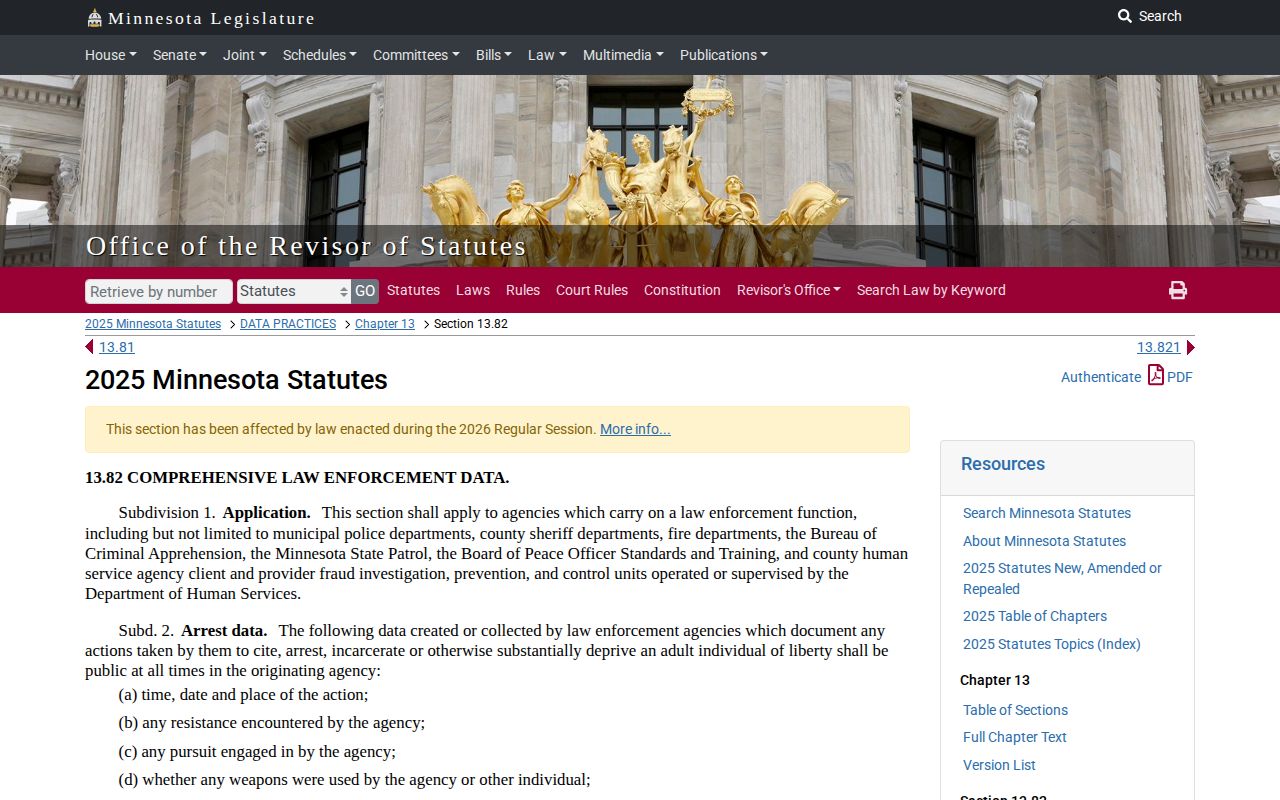
A booking photo records one step only: an intake or identification moment. It reveals nothing about whether a charge was filed, reduced, dismissed, or proved in court.
Minnesota Arrest Data and Photo Limits
While an investigation stays active, its criminal-investigation data is confidential or protected nonpublic. A booking photo may be temporarily withheld. That applies if releasing it would harm that work. Inactive investigative data is generally public. Even then, safety risks, protected identities, and other statutory limits can still block access.
One more rule: a clearly offensive image is private or nonpublic. The agency may still confirm that such an image exists. Law enforcement can also shield certain victims, witnesses, informants, and undercover personnel. A warrant is different. It is a court order authorizing an arrest or another legal step. Minnesota warrant indices stay confidential until service, custody, or a court appearance. An exception applies if disclosure serves a public purpose.
If access is denied or delayed, ask which classification applies. Ask whether the investigation exception is temporary. A requester can seek an explanation. Court review is available where appropriate. Redaction, delay, and nonpublic status are three distinct outcomes worth telling apart.
Note: A public category can still have protected fields, and one withheld image does not make the full arrest record confidential.
Minnesota Juvenile Photo Restrictions
The adult rules do not open every juvenile booking photo to the public. Minnesota Data Practices Advisory Opinion 08-030 turns on details. Access can hinge on two things. One is whether a delinquency matter is still open. The other is whether the image is part of a public court record. Treat it as narrow guidance, never as general permission to publish juvenile photos.
Section 13.82, subdivision 29 adds its own wrinkle. Photos of children adjudicated delinquent under Chapter 260B are not expunged. Law-enforcement records and databases keep them. That rule does not put them online. The person may have been under 18. Ask the agency or the court to classify the record under the rules for that specific case.
Minnesota Mugshot Publication Varies
Counties across Minnesota publish in very different ways. Some run image-capable search portals, others live custody lists, text rosters, PDFs, or nothing but a direct request path. Ramsey County offers an open-data roster. Becker County keeps a live list without confirmed photos. Kanabec County has an image-capable locator. These are different interfaces, not different state-law standards.
The gaps between them matter. A roster may cover only people still in jail, while the arrest report stays with the arresting agency after release. Some counties hand over photos only on request. Section 13.82, subdivision 18 does not require a sheriff to build a statewide feed or add fields it never maintained. A county directory can point to the right custodian. Only the agency that made the record can confirm its status.
Minnesota Mugshot Law History
Minnesota's photo-access rule grew out of data-practices law. It did not come from any statute aimed at private publishers. Advisory Opinion 94-020 walks through the 1995 change. That change clarified how booking photos are treated as public. Opinion 95-004 covers detention and access under §13.82. The current Revisor text governs in the end.
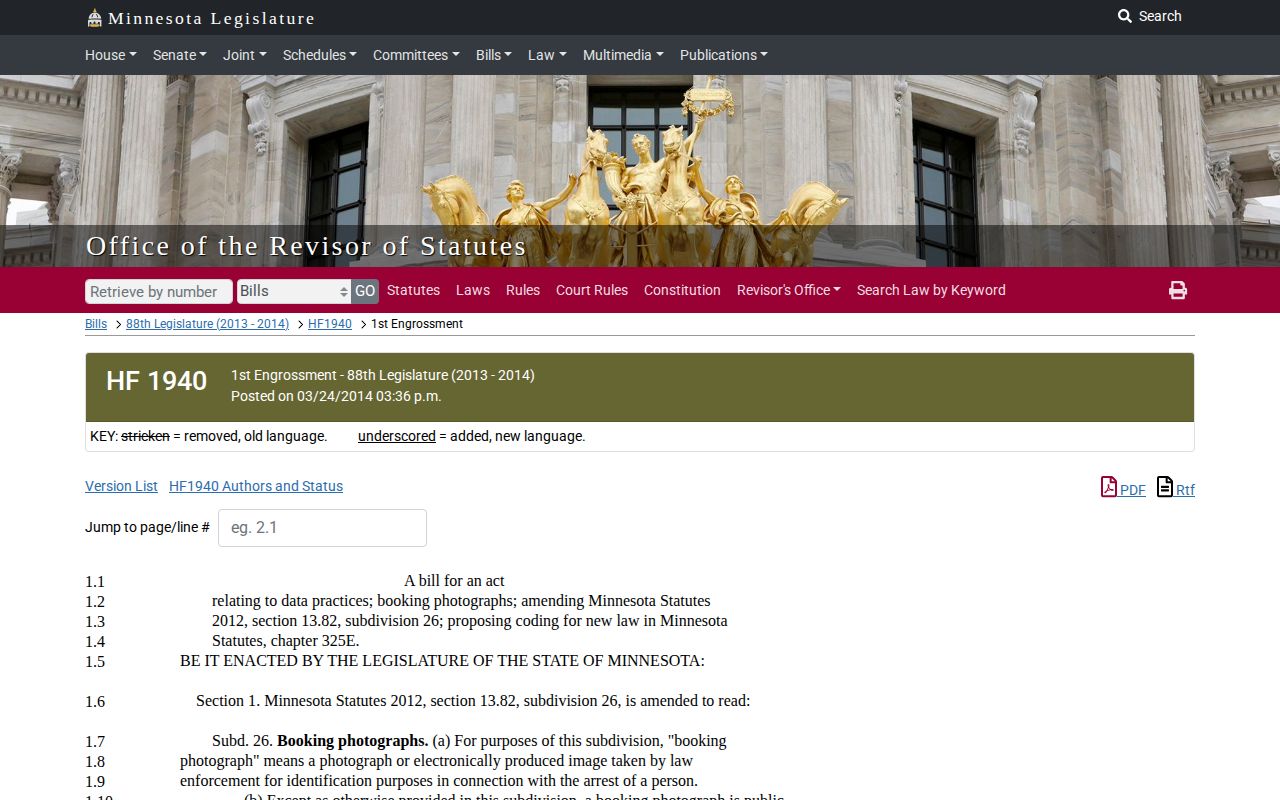
There is no enacted, general anti-pay-to-remove statute here. In 2014, HF 1940 and its companion SF 1863 proposed changes to §325E.80. Lawmakers had heard concerns about pressure to pay for photo removal. The bill would have required a free removal route and addressed favorable outcomes. It died without becoming law. The §325E.80 on the books today covers unrelated ground. The House Session Daily report and the HF 1940 text document that history. They do not document a current right.
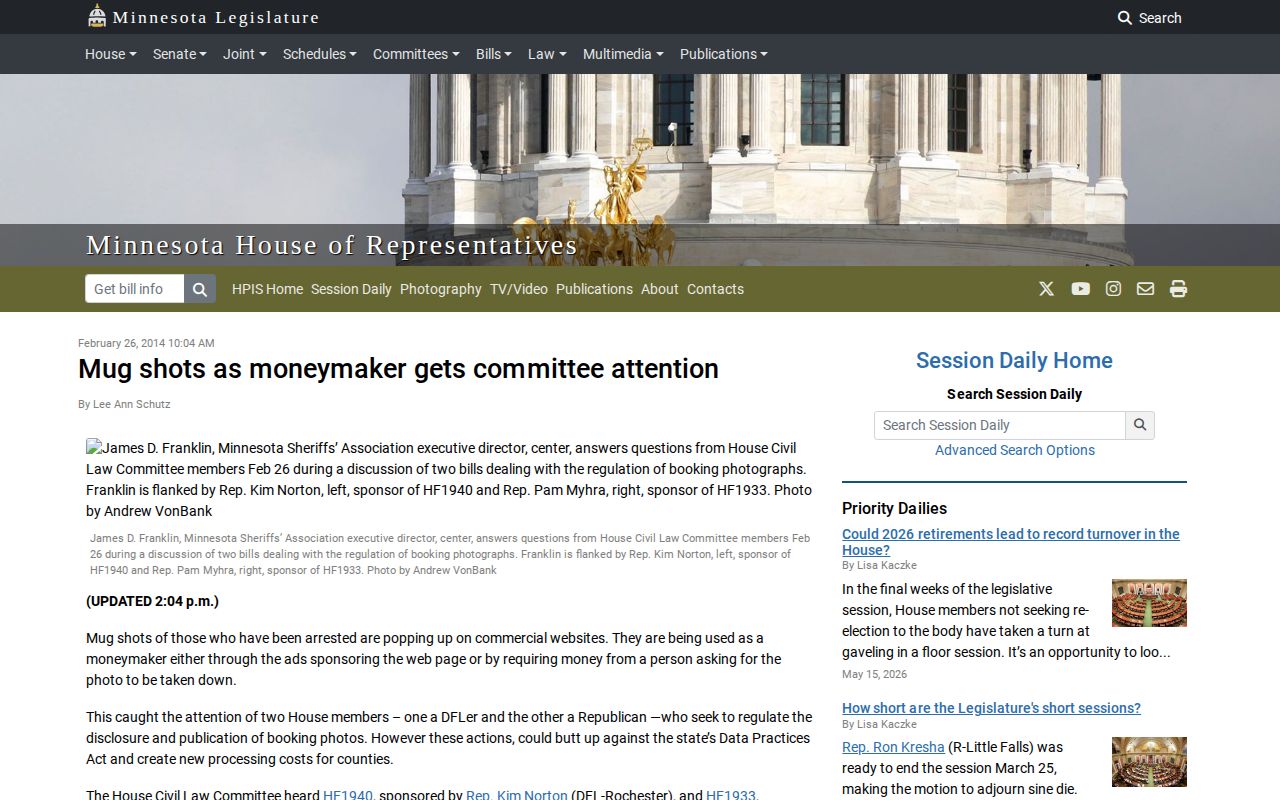
People sometimes cite Minnesota Statutes §325E.80 as the state's mugshot-removal law. That citation is wrong. The statute on the books is not the proposal that failed.
The HF 1940 version page preserves the bill's proposed wording. Keep it for history's sake. Treat it as a proposal only.
Federal litigation has touched on booking photos too. In Al-Kadi v. Ramsey County, the court addressed a booking image taken without the plaintiff's hijab and later republished. The county did not post photos online. It did acknowledge a duty to release qualifying data on request. The decision covered the public-photo rule plus separate accommodation and publication issues. It created no anti-pay-to-remove statute.
State v. Trawick and State v. Ramsey are different animals entirely. Those rulings dealt with booking images as evidence in criminal cases, not with commercial publication.
Requesting Minnesota Arrest Records
No photo on the roster? Start with the agency that made the arrest. A released person may drop off a custody list. That same office holds the booking or arrest record. City police, county sheriffs, courts, and the Minnesota Department of Corrections each keep separate files.
Give the office a name, a date, and enough detail to locate the file. One focused request beats asking for every Minnesota photo.
- Identify the agency and record type, such as a booking photo, arrest report, or incident record.
- Give the person’s name, booking or incident date, county, and case number if known.
- Ask to inspect the record or receive a copy, and check whether a copy charge applies.
- If access is denied or delayed, ask for the legal classification and whether an active investigation is the reason.
Agencies have limits. They need not create new fields or merge county records they never kept. Ask whether the record was transferred or destroyed under a retention schedule. Fees and response times vary. Each office sets its own.
Minnesota Court Records and Dispositions
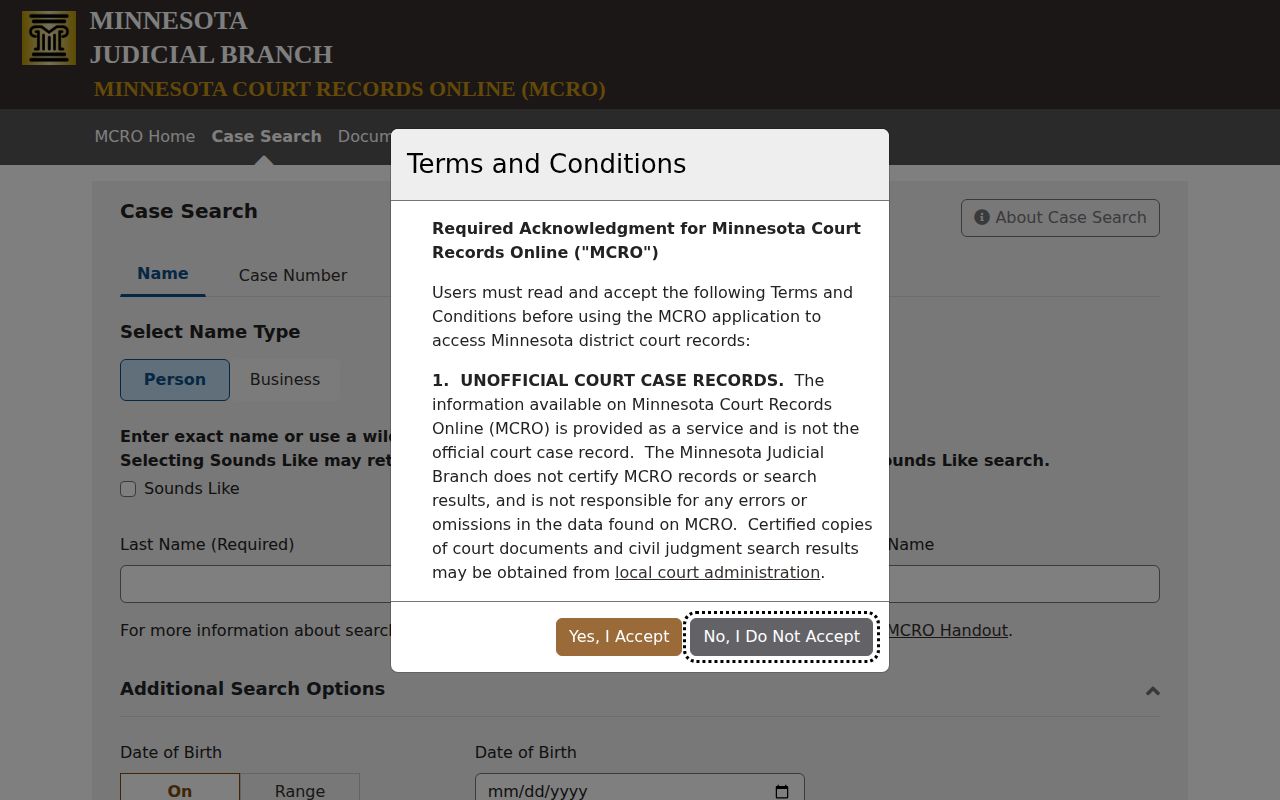
Found the arresting agency? Take the next step with the MCRO portal, Minnesota Court Records Online. It searches by name, business, attorney, case number, citation, or bar number. A disposition is simply the court's recorded outcome. Read the register of actions and any public disposition before describing a result.
MCRO has real gaps. It is unofficial and incomplete. A pending criminal, traffic, or petty-misdemeanor case without a conviction may not appear under a defendant's name. Search by case or citation number where you can. Then match county, date of birth, and other identifiers. Courthouse terminals and the State Law Library hold records missing from the web. Juvenile, protected, older, and destroyed records sit outside any general search. And an empty result proves nothing. It does not mean no arrest or case exists. The portal is not a statewide jail roster.
Prison is a different system. For someone sentenced to state prison or still under supervision, use the MNDOC offender-photo and profile search. A prison profile is not a county booking record.
Note: A court result can lag behind an arrest, and a missing online name search is not a final case-status finding.
Minnesota Expungement and Sealing
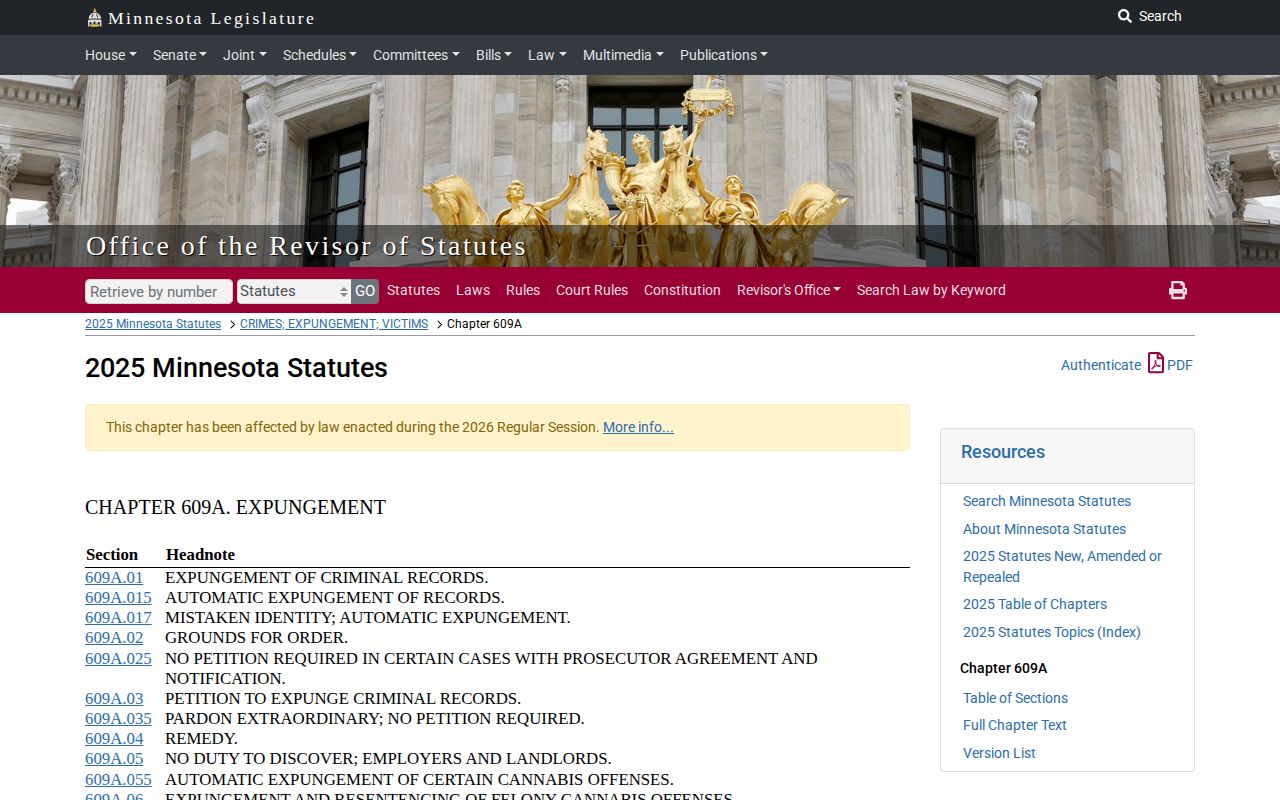
Chapter 609A is Minnesota's sealing law. It generally seals qualifying records from public view. But sealing destroys nothing, and it never reclaims every copy. Covered agencies may need to classify records as private while preserving listed criminal-justice access. An order reaches only the records and agencies within its scope.
Some relief happens automatically under Section 609A.015. Covered cases include certain arrests followed by dismissal or another favorable result, qualifying diversion or stays, and eligible convictions after waiting periods. Diversion or a stay can pause a case under court-set terms. Everything else takes a petition under §§609A.02 to .05. Notice is required, and a court decides. Timing depends on the disposition and the offense. Some favorable nonconviction cases qualify right away. Certain diversion or stay cases carry a one-year wait, while convictions wait longer.
The Judicial Branch posts criminal expungement forms for petitioners. The Attorney General no longer accepts individual applications. It points people to the prosecutor and court process. The BCA's public Criminal History System excludes sealed data, though it is no jail roster or booking-photo search.
For any real question, the full Chapter 609A text controls. Check the subsection matching the exact case rather than trusting a broad summary.
Sealing has boundaries. It changes what an agency may disclose but promises nothing about an unrelated private archive holding an older copy. Confirm the order first. Check which agencies it covers and how the government record is now classified. If a third-party page is wrong or lingers after relief, send the official order or disposition. Use that publisher's own correction route.
Note: A sealed government record may remain preserved for lawful uses, even when the public cannot see it.
Correcting Minnesota Publisher Records
Private publishers write their own correction policies. Those rules sit apart from public-record law and court orders. Their listings are secondary copies that go stale, so compare them against the arresting agency and MCRO. A free route creates no right to deletion. No response time is guaranteed. Send the direct listing URL along with the official record supporting a correction, dismissal, favorable disposition, or sealing order.
| Publisher route | What the reviewed policy says |
|---|---|
| BustedNewspaper form | Its free route asks for the listing URL, reason, and legal proof such as a dismissal or expungement. It says review may take about five to ten days, not that removal is assured. |
| RecentlyBooked policy | It states there is no fee and describes requests for wrong identity, outdated data, juvenile records, duplicates, dismissal, or sealing. Accurate current public information may remain. |
| Arrests.org contact route | The reviewed contact page did not show a separate Minnesota free-removal process. No result or fee should be assumed. |
Each Minnesota publisher sets its own removal terms. BustedNewspaper asks for the listing URL, contact details, a reason, and legal papers. RecentlyBooked wants the listing link, identity information, an explanation, and supporting documents. The Arrests.org contact page lists no separate Minnesota free-removal procedure. Expect a general request path there. Policies shift over time. A publisher can decline a request or keep accurate current information online.
News stories work differently. Ask for a correction or a status update rather than guaranteed deletion. MPR's ethics policy and the Star Tribune's corrections channel offer free routes for review. So do the newsroom contacts at WCCO and KSTP. Include the article URL, case number, and any official order or disposition.
Watch for removal scams. Anyone promising guaranteed deletion for a fee is waving a red flag. So is anyone claiming payment is the only path. Minnesota never enacted the 2014 proposal for a statutory free-removal process. Stick with documented agency, court, and publisher routes. Treat a web copy as no proof that a government record stays public.
Minnesota Mugshot Records Need Context
A roster, an arrest report, a news story, and a court disposition each describe a different stage of the same case. Charges can change or be dismissed. Release can happen long before a case ends, so check the latest court record for current status.
This is general legal information, not advice for a particular case. The record custodian can explain a classification, while a court or a lawyer can handle an expungement question.
Note: Use a current court order or register entry to describe a case outcome, then ask the original custodian about the record’s status.